Ledger
Project details
Project highlights
0
external tabs to reach a verdict
5
material checks, scored apart
0
contrast failures, light and dark
A submission review layer for hiring. Every candidate's repository, live demo, screenshots and walkthrough live in one reviewable surface, with scoring that separates what a candidate shipped from what they merely claimed.
Agentic AI · Design SystemsDesign · Front end · Exercise · concept
A time poor reviewer should be able to understand one submission, inspect the evidence behind it, and reach a fair decision without leaving the page. Everything below follows from that sentence.
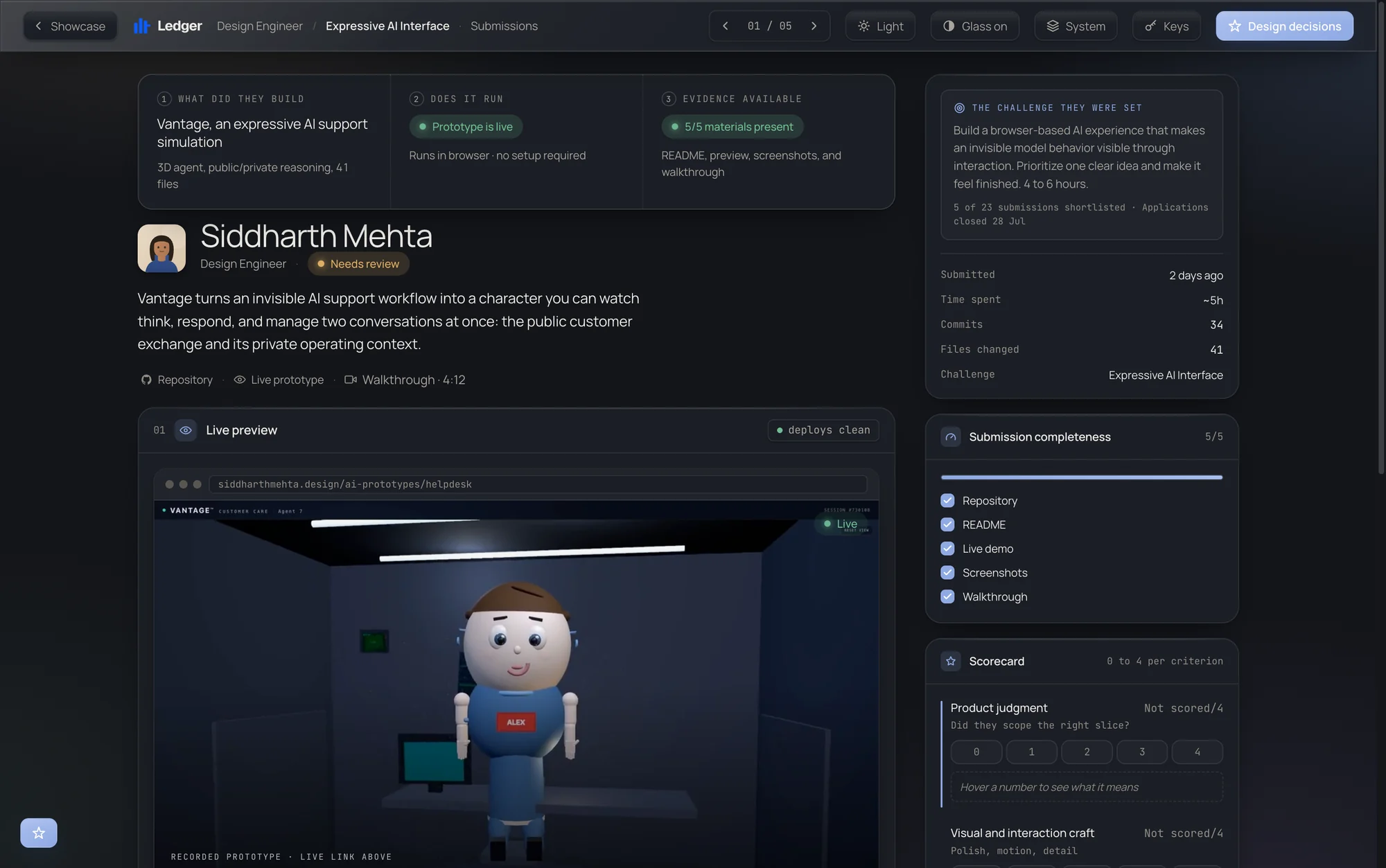
The legacy tool, running. Four links per candidate, a prototype that fails to load, and a review form that asks for a verdict on work the reviewer can no longer see.
Memory becomes the system. A reviewer is asked to hold four tabs and a broken preview in their head, and then to rate something they half remember, twenty three times in one sitting. Every decision after the first is made against a fading copy of the work.
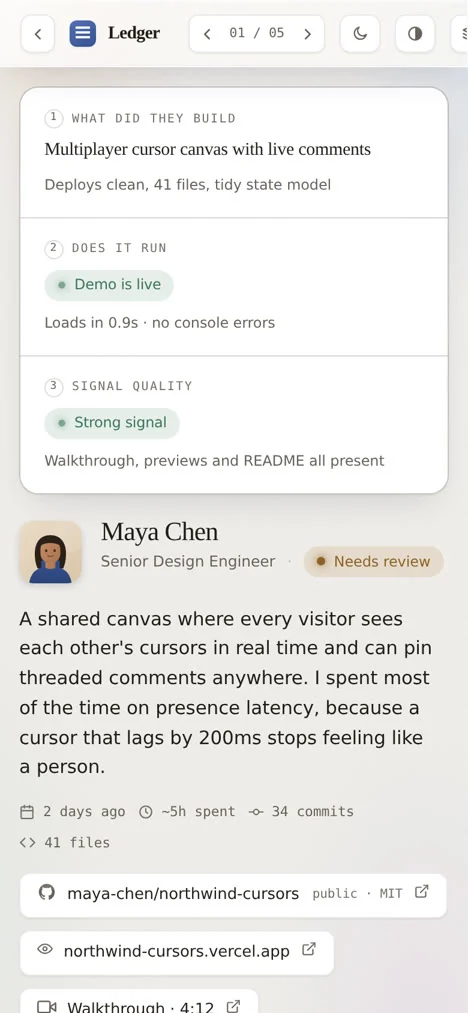
One surface. The repository, the live demo, the walkthrough and the README are tabs on the submission rather than tabs in the browser, and the prototype runs inside the page being scored.
Evidence, then a decision. What the repository actually contains sits beside what the candidate claimed, and the reviewer advances to the next submission without losing the thread.
Calibration before anyone moves forward. Two reviewers disagreeing is surfaced as a thing to resolve, not averaged away, and the finalists leave as a packaged handoff.
The real thing, running in this browser. Review a candidate, score them against the rubric, and take the shortlist to a handoff.
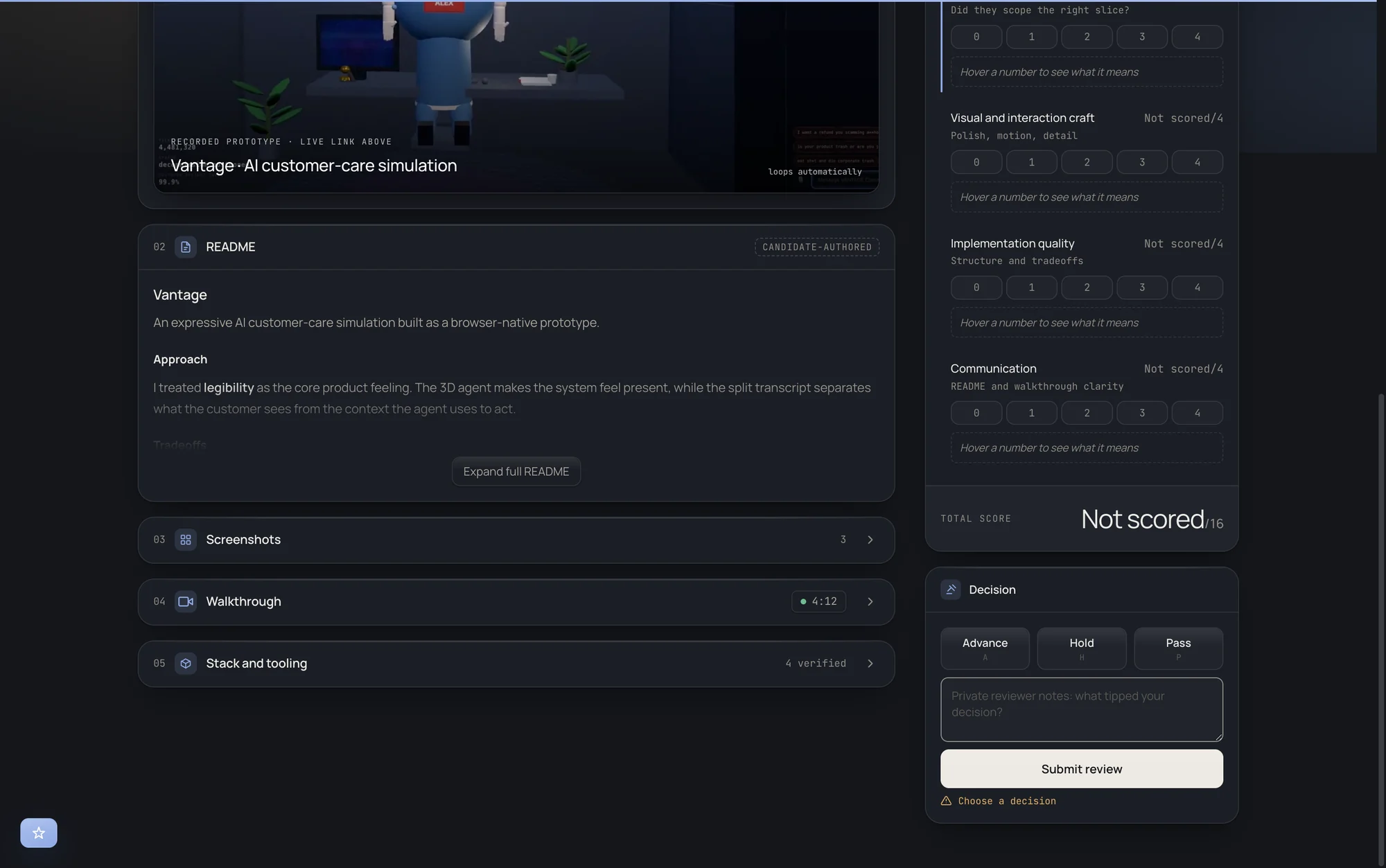
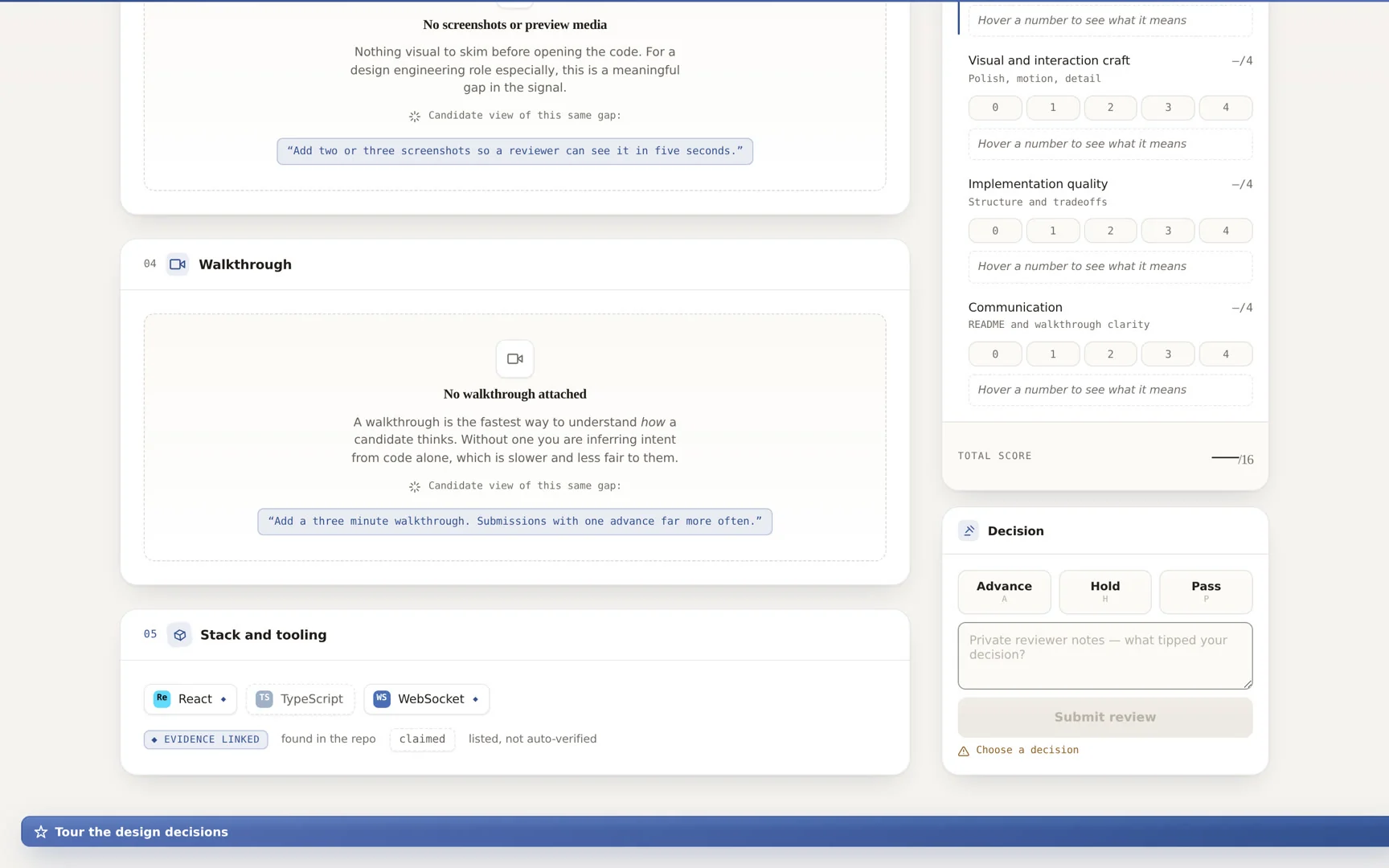
Completeness is counted separately from quality, so a missing README never reads as weak work.
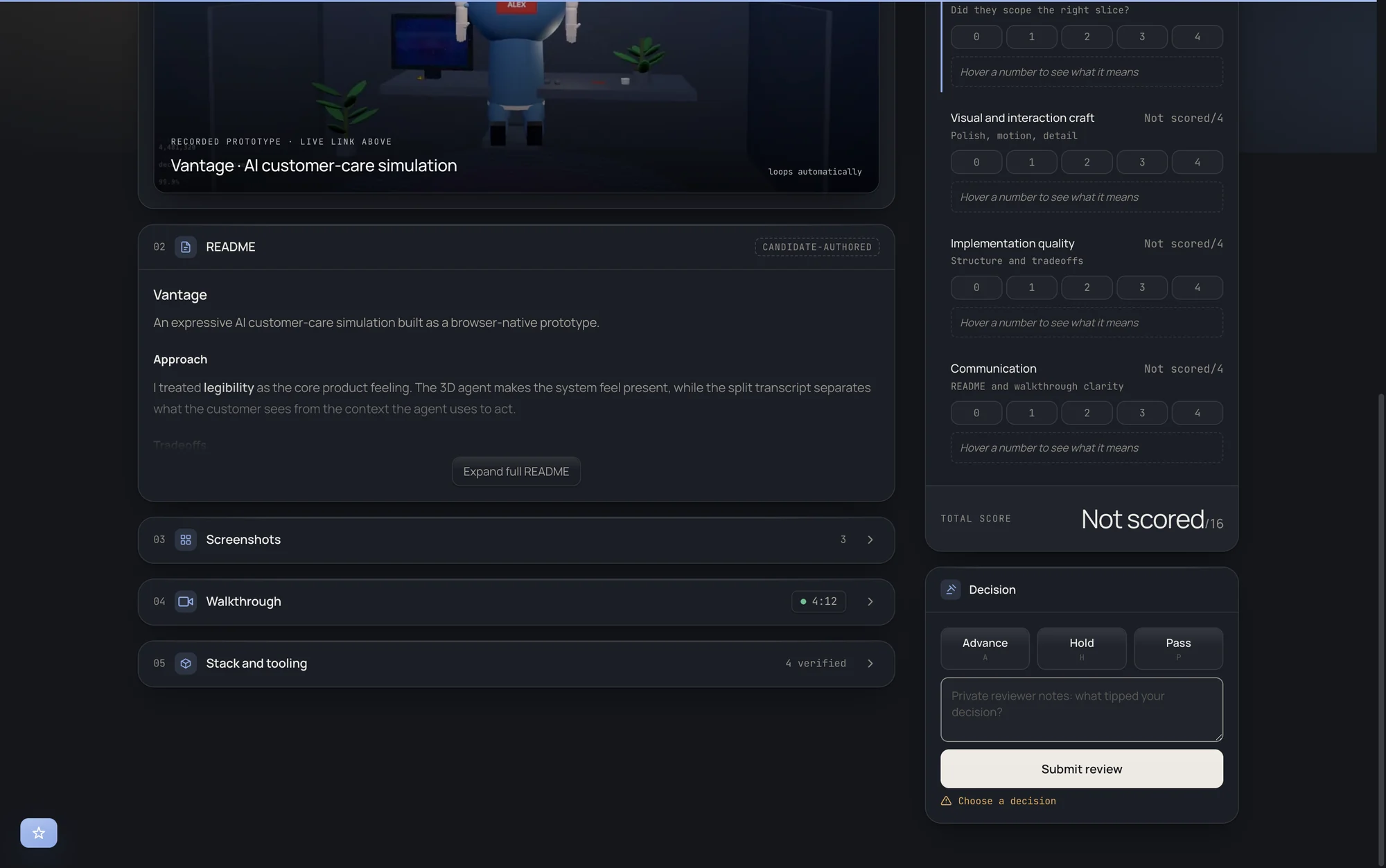
A claimed stack becomes an inspectable one. What the candidate said, against what the repository shows.
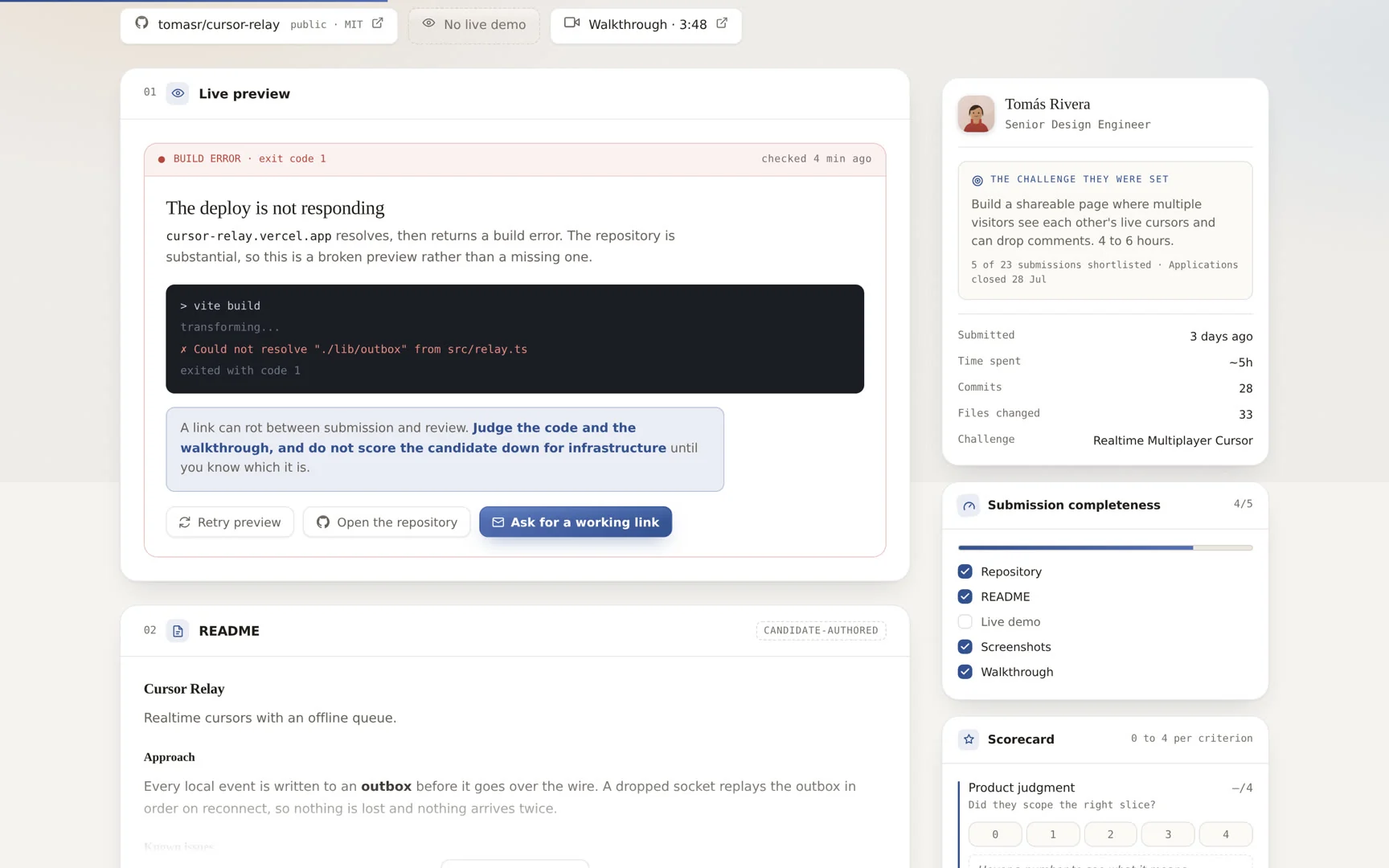
A broken deploy is not the same as absent work, and the interface refuses to score them alike.
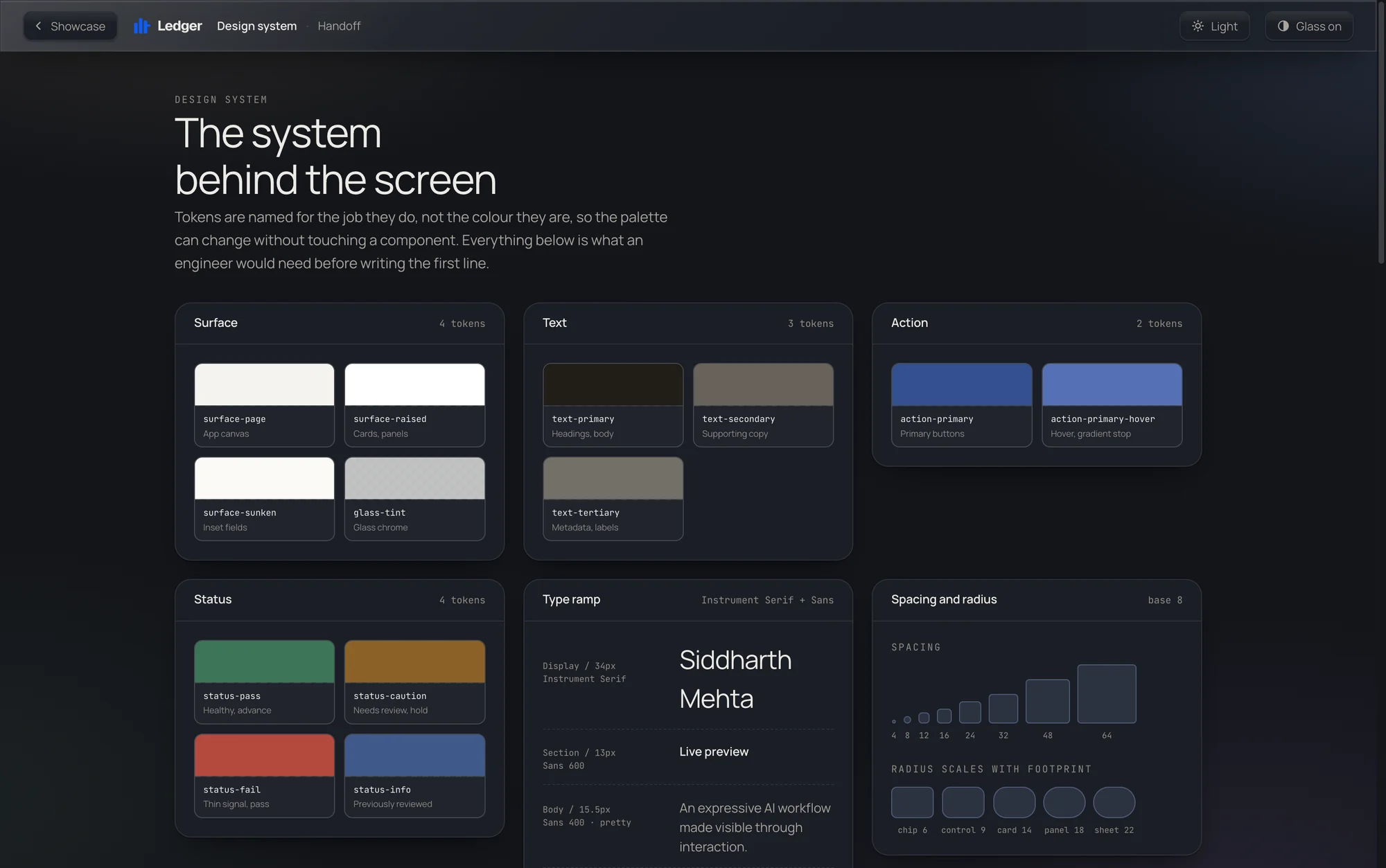
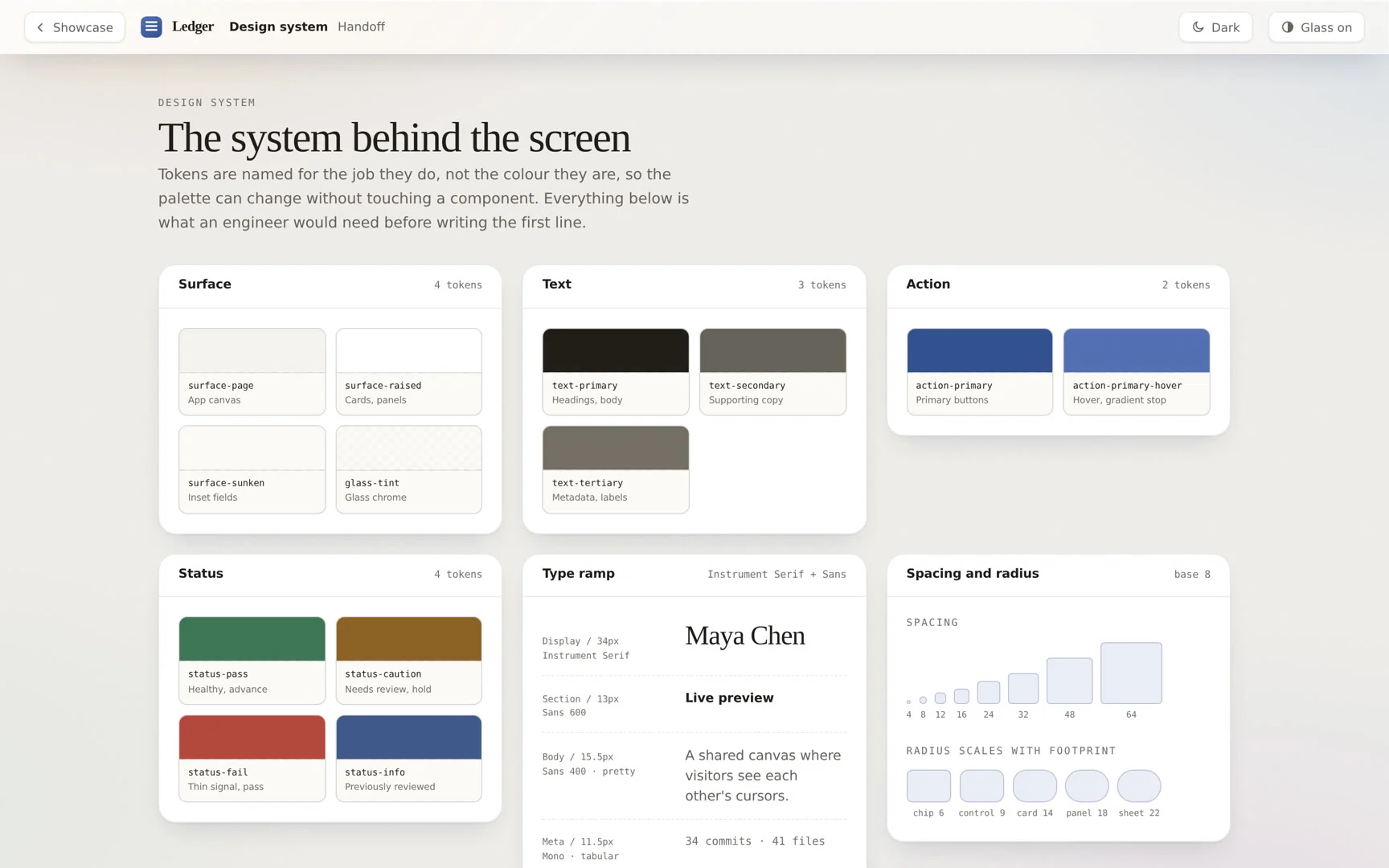
The system view is part of the prototype rather than a document beside it: tokens, component anatomy, the state matrix and the accessibility contract are all inspectable from inside the thing they describe. Contrast is audited in a script that runs against both themes and reports zero failures.
Back to top↑The decision I would defend hardest is separating whether a submission is complete from whether it is good. Those two questions arrive at the same moment and a single star rating collapses them, so a candidate who shipped strong work with no README scores like a candidate who shipped nothing. Pulling them apart cost a column of screen and made every score afterwards mean something narrower and more honest. The one I would revisit is the anchored rubric. Writing behavioural descriptions for every point on every criterion is the reason a reviewer can score consistently at submission nineteen, and it is also the heaviest thing on the page. I would want to watch somebody use it for an hour before defending the weight.
 Next project Obin→ An agent writes the credit memo in four minutes. Then an analyst checks every number in... Back to top↑